
The Problem
Organisations with diverse lines of business often face a tricky challenge: each unit has its own customers, priorities, and digital ambitions. It makes sense for them to develop tailored strategies—but without an overarching framework, things can quickly become messy.
The result? Overlapping initiatives, duplicated investments, and confusion about what “digital transformation” really means for the enterprise.
The Approach
The key is to balance autonomy with alignment. Here’s how:
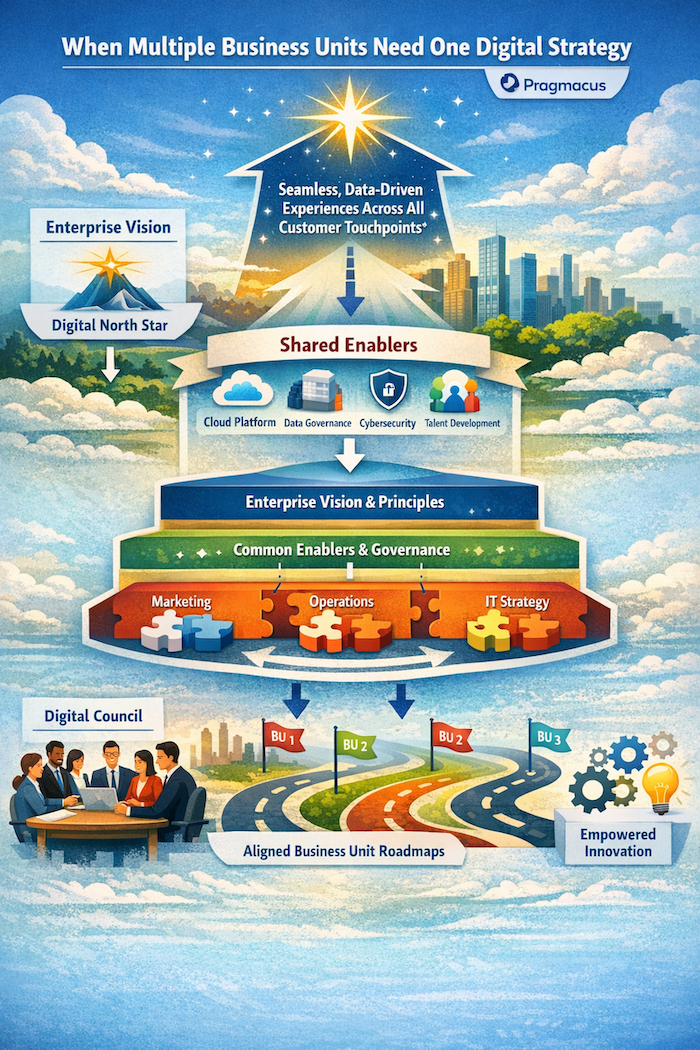
- Define a Digital North Star
Start with a clear enterprise-level vision. This isn’t about prescribing every detail—it’s about setting the destination. For example: “Deliver seamless, data-driven experiences across all customer touchpoints.” - Create Common Enablers
Identify shared capabilities that every business unit can leverage—think cloud platforms, data governance, cybersecurity standards, and talent development. These become the backbone of your overarching strategy. - Cascade, Don’t Dictate
Map each business unit’s digital priorities to the enterprise vision. Use a simple cascade:
Enterprise Vision → Shared Enablers → Business Unit Roadmaps.
This keeps strategies connected without forcing uniformity. - Communicate in Layers
Avoid confusion by structuring your strategy in three layers:- Top Layer: Enterprise vision and guiding principles.
- Middle Layer: Shared enablers and governance.
- Bottom Layer: Business unit-specific strategies.
- Govern Without Bureaucracy
Establish a digital council to align priorities and resolve overlaps. Empower business units to innovate within agreed guardrails.
This approach gives each line of business the freedom to pursue what matters most to its customers, while ensuring the organisation moves forward as one. No duplication, no confusion—just clarity and momentum.