
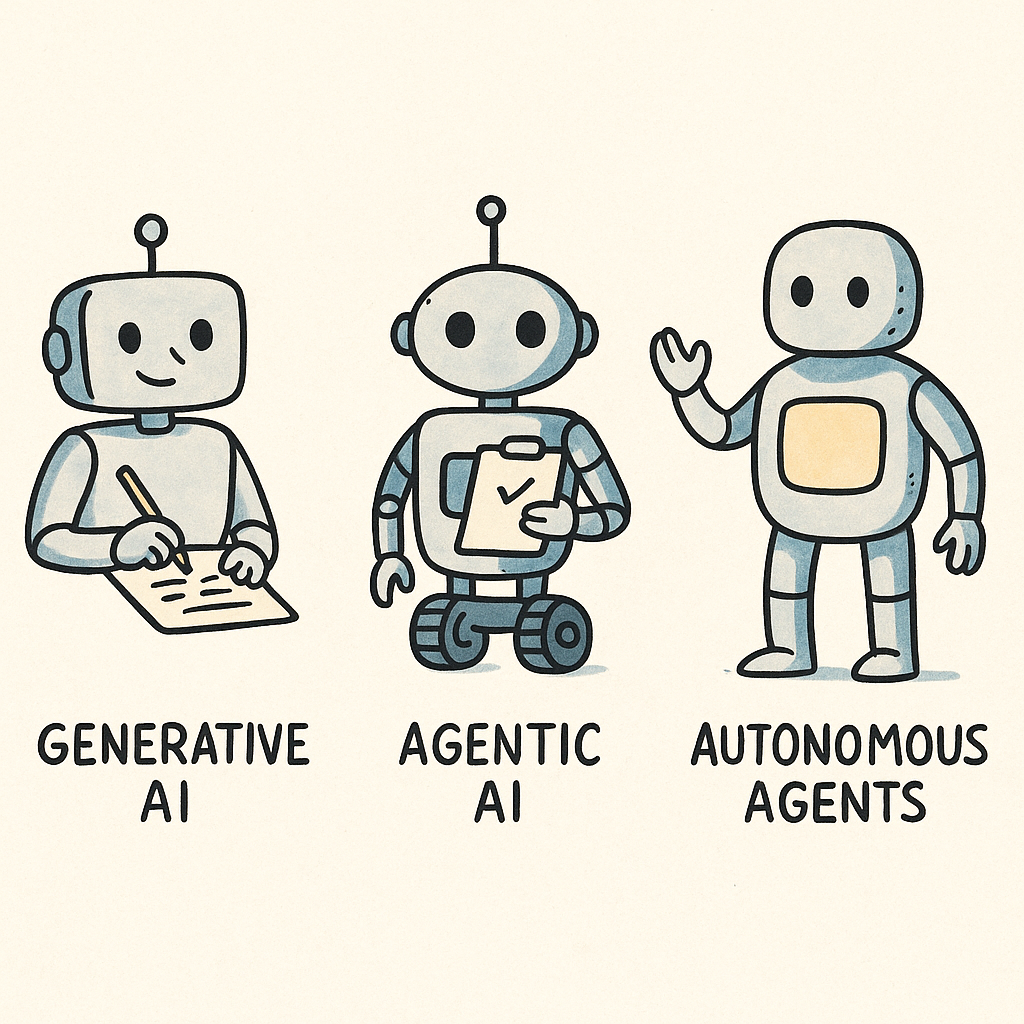
AI is no longer a futuristic concept—it has become a practical, everyday enabler transforming how organisations work. Yet not all AI operates the same way. At Pragmacus, we see three distinct modes of AI emerging inside modern enterprises, each playing a different role in improving efficiency, insight, and innovation.
1. Generative AI – The Assistant
This is the form of AI most people are familiar with today. Generative tools such as ChatGPT, Claude, and Google Gemini help teams write reports, synthesise research, summarise meetings, produce marketing content, and brainstorm ideas.
It is human-initiated and human-directed—a highly capable digital assistant that enhances productivity, reduces cognitive load, and accelerates content creation.
Typical use case:
Marketing and sales teams generating draft campaigns, client proposals, product descriptions, meeting summaries, and first-pass research.
2. Agentic AI – The Task Performer
Agentic AI goes beyond content generation. These systems perform tasks on behalf of a human, usually triggered by a prompt, rule, or instruction. They can schedule meetings, send follow-ups, analyse data across systems, or move information between tools.
The key distinction: Agentic AI exhibits limited autonomy. It executes tasks within defined boundaries but still relies on human initiation or oversight.
Typical use case:
Customer service teams deploying an agent that auto-responds to routine enquiries, drafts escalation notes, or retrieves customer records when a ticket is opened.
3. Autonomous AI Agents – The Workflow Partner
This is the emerging frontier of enterprise AI. Autonomous agents operate as part of an organisation’s workflow, making decisions and taking actions without direct human prompts. They observe, plan, collaborate with other systems or agents, and optimise processes dynamically.
Unlike simple task automation, these agents behave like digital colleagues—monitoring events, reacting to changes, and contributing to outcomes.
Typical use case:
A logistics agent that continuously monitors delivery routes, traffic, weather, and fleet status—automatically rerouting drivers or adjusting schedules without human intervention.
Why This Distinction Matters
Recognising these three layers of AI helps leaders determine where each type fits into the organisational operating model. Not every problem requires autonomy, and not every team is ready to adopt agentic workflows.
At Pragmacus, we help organisations design the right combination of AI capabilities to support their strategy—whether that means improving lead quality, embedding intelligence into CRM processes, enhancing customer journeys, or increasing operational efficiency.
AI isn’t just about automation—it’s about augmenting human capability. Understanding which category of AI you are deploying is the first step toward using it purposefully, safely, and effectively.