
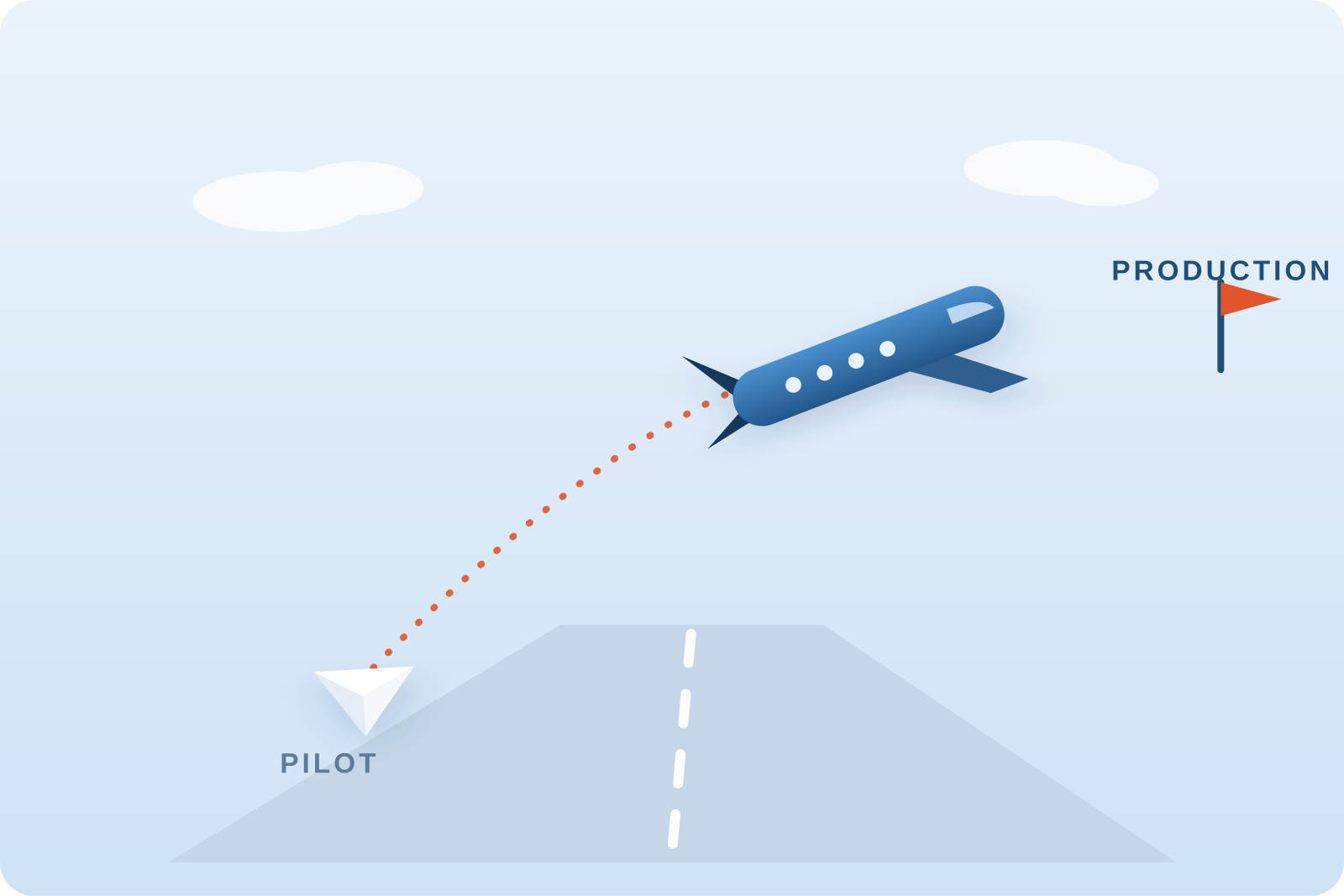
Almost every organisation we speak to has run an AI pilot. Far fewer have AI running in production, earning its keep day after day. The gap between a promising proof-of-concept and a dependable, in-use capability is where most AI investment quietly stalls — and it usually has little to do with the model itself.
Why pilots stall
A pilot only has to answer one question: could this work? Production has to answer harder ones — will it work reliably, securely, at acceptable cost, and within the way the organisation actually operates? Pilots run on clean data, in a sandbox, championed by enthusiasts. Production has to cope with messy data, integration, monitoring, support, and people whose day-to-day work changes. When those realities arrive, the demo that dazzled often can’t stand up.
What gets AI into production
A few things consistently separate the initiatives that scale:
- A real business owner — someone accountable for the outcome, not just a technical sponsor for the experiment.
- Production-grade data and plumbing — pipelines, access and quality you can trust without a data scientist babysitting them.
- Operating-model change — clear decisions on who reviews outputs, who handles exceptions, and how the workflow actually shifts.
- A maintenance plan — models drift, so someone has to monitor, retrain and own them over time.
The pragmatic takeaway
The answer isn’t to run fewer pilots — it’s to design them for the destination. Before you start, ask what production would demand if the pilot succeeds, and make sure there’s an owner and a credible path to get there. The value in AI comes from the unglamorous work after the demo, not the demo itself.