
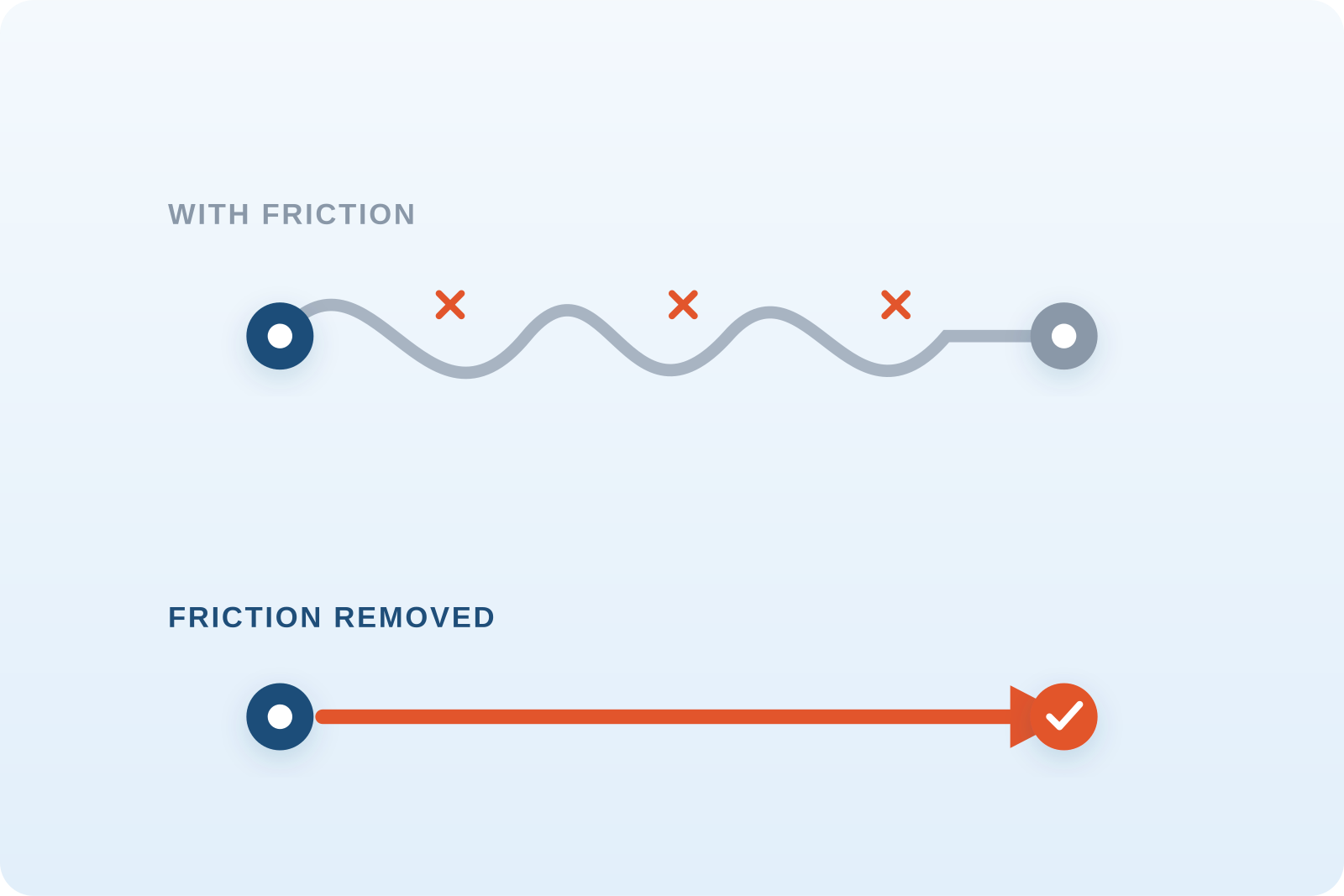
When organisations want to lift productivity, the instinct is to push people to work faster or add another tool. But speed is rarely the real constraint. In most processes, the loss isn’t how fast people work — it’s how much friction sits between the steps.
Where the time really goes
Watch almost any everyday process and you’ll see it: waiting on an approval, re-keying the same data into three systems, chasing a missing attachment, redoing work because the brief was unclear. None of that is slow effort — it’s wasted effort. People are often working hard inside a process that’s quietly working against them.
Remove friction before adding speed
Lean thinking offers a simple discipline: before you automate or accelerate anything, remove the steps that shouldn’t exist. Map the process as it actually runs, find the hand-offs, waits and rework, and strip them out. The biggest gains often come not from doing things faster, but from not doing them at all. A useful test for each step: would the customer happily pay for it? If not, and it isn’t a genuine control, it’s a candidate for removal.
This matters because friction compounds. A two-minute delay repeated across hundreds of transactions is a hidden tax on the whole organisation — and unlike “work faster”, removing friction makes the work better, not just harder. Start there, and the speed tends to follow.
-------
There is surely nothing quite so useless as doing with great efficiency what should not be done at all.
Peter Drucker