
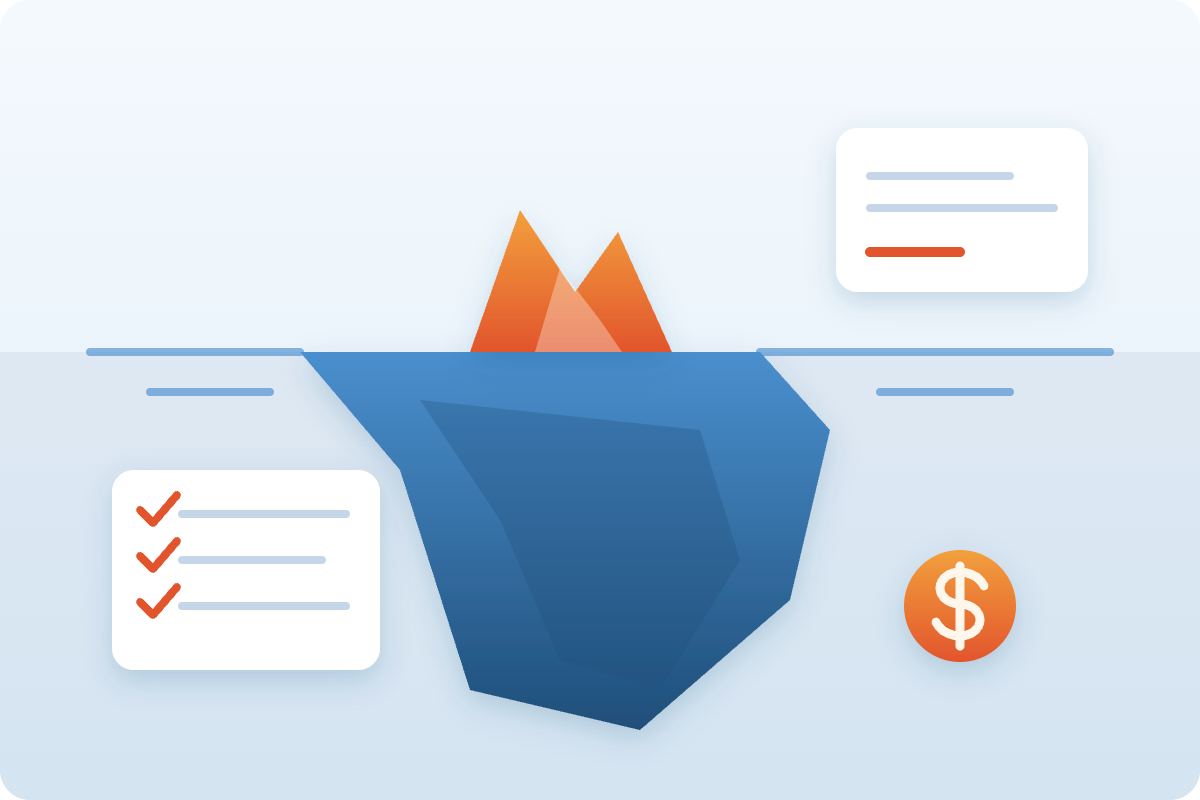
An AI business case usually starts on a vendor’s pricing page. A few dozen dollars per user per month, multiplied by headcount, looks almost trivial next to the productivity gain being promised. Twelve months later, the licences are the smallest line in the ledger, the benefits are still being described as “emerging”, and someone asks what happened. The licence fee was never the cost of AI. It was the entry ticket to a piece of work most organisations underestimate before they start.
Where the money actually goes
The spending that determines whether AI pays off almost all sits outside the subscription:
- Getting the data fit to use — many AI disappointments are data problems in disguise: duplicated records, undocumented fields, and the knowledge that only exists in someone’s inbox.
- Integration and plumbing — a tool that cannot reach your core systems produces demonstrations, not outcomes. Connecting it safely takes engineering effort and, often, a vendor negotiation.
- Redesigning the work — dropping AI into an unchanged process simply automates the current mess faster. The saving comes from the redesign, and redesign takes time from your busiest people.
- Capability and change — training, internal champions, and the weeks where teams run the old way and the new way side by side because neither can be switched off yet.
- Oversight and assurance — someone has to review outputs, keep the policy current and answer for decisions the model influenced. That effort is ongoing, not a one-off project cost.
Costing it honestly makes the case stronger
Counter-intuitively, a full-cost view tends to help rather than hinder. It forces a choice between three or four uses that genuinely matter and a dozen experiments competing for the same scarce attention. It surfaces the shared investments — clean data, a repeatable integration pattern, a governance model that works — which make the second and third use case far cheaper than the first. And it makes the comparison an honest one, because the cost of doing nothing is already being paid in re-keying, rework and slow answers. It just never arrives as an invoice.
The pragmatic takeaway
The number on the vendor’s pricing page and the cost of the change are not the same figure, and only one of them arrives as an invoice. Before the next AI proposal reaches your board or executive team, ask for the whole number: licences, data work, integration, process redesign, training and ongoing oversight, over three years rather than one. Then ask what the organisation will stop doing in order to fund it. A business case that survives both questions is worth backing. One that only survives on the licence fee was never a business case in the first place.